

Using Artificial Intelligence
ChatGPT and other generative chat tools are designed to give human-like responses to questions rather than simply retrieving information. Accessible and seemingly comprehensive, this can make the responses useful as a springboard for questions to ask your doctor or to guide your own research.
Benefits
- Quick and convenient – Get answers to medical questions anytime.
- Easy to understand – Can explain medical terms in simple language.
- Helps with questions – Can suggest what to ask your doctor.
- Summarizes information – Can provide overviews of conditions or medications.
Cautions (and actions)
- Not a doctor – AI cannot diagnose or replace professional medical advice.
- Action: An important aspect of online information is knowing its limits; you are an expert in being you, but not necessarily in the many presentations of a specific disease or set of symptoms. Take what you learn from your research and your lived experience, and share that with a professional who has the relevant expertise.
- Misinformation risk – Not all sources are reliable; some answers may be outdated or inaccurate.
- Action: Take the time to go directly to the source to determine if the information is reliable and current. Be wary if the objective of the source is to sell you something.
- Not personalized – AI provides general info, not specific to you.
- Data is being collected – As always when online, be aware of tracking.
- Action: The major web browsers and search engines track your search activity by default. You may want to use the “private browsing” or “incognito” feature of your browser to reduce some of that tracking, though your activity is still visible to your ISP, network administrator or law enforcement (with a warrant). Also, if you login to a website, that site will be able to track your activity.
- Action: The major web browsers and search engines track your search activity by default. You may want to use the “private browsing” or “incognito” feature of your browser to reduce some of that tracking, though your activity is still visible to your ISP, network administrator or law enforcement (with a warrant). Also, if you login to a website, that site will be able to track your activity.
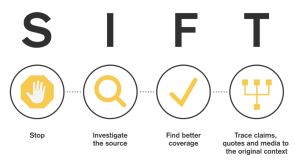
Artificial intelligence is ever evolving. Developed using “large language models” (LLMs), these big datasets can be imperfect as training date – they are massive, messy, and mimetic. These datasets reflect what is most said not necessarily what is most accurate. They can include deliberate misinformation, historial bias and censorship, even dominant but ultimately incorrect narratives (think about the once accepted wisdom of blood letting!). LLMs don’t know truth, they know patterns. As AI evolves, keep an ear out for how these challenges are being met. Until then….. you know what to do…..SIFT!