

Health Topics
#1 TIME SAVING TIP: At your first page of results, don’t waste time on analysis. Instead, look for context. Ask: Does this make sense to me? Do I know what I’m looking at?
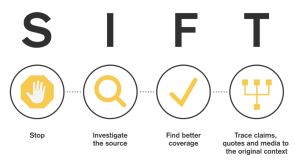 STOP: What do you really know about the claim being made or the source that’s sharing it? Do know what you’re looking at (are you sure)? Also, consider why it might be upsetting or surprising? Why might that be?
- INVESTIGATE THE SOURCE: Do a quick check to see of the source is trustworthy for this purpose. Often, you can stop here if the source is good.
- FIND OTHER COVERAGE: Whether a news report out a research claim, take a second to zoom out and see what other sources say. If the story or claim is not being picked up by other reputable sources, proceed cautiously.
- TRACE THE CLAIM, QUOTE, OR MEDIA TO THE ORIGINAL CONTEXT: Sometimes the first source you encountered isn’t great, but it links to where it got its information. Go the original source and judge (a) whether it’s reputable, and (b) whether it actually supports the assertion.
Use this approach especially when looking at an artificial intelligence generated summary.
For more on SIFT and how to check sources and claims found online, read Verified: How to think straight, get duped less, and make better decisions about what to believe online, by Mike Caulfield & Sam Wineberg, c2023 and available through the Westchester Library System.
The sites below can help you quickly understand a topic and identify sources for further information in your specific areas of interest. Think of MedlinePlus as an annotated table of contents for your notebook on a topic. Then, explore more deeply at specialist sites. For example, if researching a nutritional supplement, see also our section on Drugs and Supplements,
- Search and find plain-language information about diseases, conditions, drugs, supplements, clinical trials, wellness and more.
- Get to understand symptoms, causes and treatments – and when to see a doctor.
- Relevant for all ages, from infants to older adults.
- Includes information on complementary/alternative health.
- Comprehensive resource produced by the National Library of Medicine that provides a roadmap to organizations that specialize in each topic.
- Covers a wide range of medical topics, including disorders, tests, diagnoses, and drugs, for both healthcare professionals and the general public.
- Includes links to additional information and source articles.
- Consumer version has a symptom checker.
- Produced by Merck & Co, Inc.
- Tip: Toggle between Consumer and Professional versions – the difference is instructive!
- Learn more at this family resource, which covers infants, children, adolescents and young adults.
- Includes a symptom checker for more detailed info.
- Provided by the American Academy of Pediatrics (also referenced in MedlinePlus).
National Center for Complementary and Integrative Health
- Better understand scientific research on complementary and integrative health approaches.
- Provides a browsable A-Z index and fact-sheets specific to the topic.
- See guidance on choosing a complementary health provider under “Health Services.”
- Provided by the National Institutes of Health (also referenced in MedlinePlus).
- A health-specific search engine that offers a cleanly presented compilation of results.
- Focuses on free and open access content.
- Note tabs for “All Results” and “Journals.”
FOR A DEEPER DIVE
Once familiar with a topic, you may want to explore the medical literature to gain a fuller understanding of treatments and effectiveness. Therefore, PubMed and related resources are recommended.
National Library of Medicine (PubMed)
- Provides access to medical journals across disciplines, with many available as full-text.
- If only a citation or abstract is available for an article you really want to read, request it from your local library .
- Tips: Focus your searches with filters (to the left of the search results; use “review” to find articles that summarize the current thinking on a topic). Set up an account to save your searches. If you find the perfect article, check the MeSH terms (indexing) listed at the bottom of the article and try the best of those for your next search
- Worth comparing your experience – PubMed Central (PMC) provides only full text articles, essentially a subset of what is in PubMed. Content is limited to biochemistry and life sciences. With fewer filtering options you may find it easier to navigate.
Why you’ll want to look for evidence-based studies and systematic reviews. Even for a specialist, expertise is limited by what they have read, studied, and whom they have treated. Ideally, all providers have an interest in evidence-based practice – but to get that knowledge means taking a 10,000′ view of a topic, which is not an easy thing to do for a single individual. How do we know if having a mamogram every year makes a difference in early detection? For what ages is that difference most meaningful? Is a pacemaker always the best choice for treating an arythmia? Is that true for both men and women? Is it true at all ages? We know because of evidence-based analyses.
In PubMed you’ll find Cochrane Reports; these are from an organization that specializes in conducting systematic reviews. Systematic reviews are rigorous efforts to examine data from multiple studies to answer a specific question. Selection of the studies, objective review of what each provides, and skilled statistical analysis and interpretation of results are all a feature of a systematic review. Learn more about about Cochran’s work at search for their studies at Cochrane.org/evidence. It’s interesting to also see a perspective from overseas; for example from Informed Health.org which is produced by Germany’s Institute for Quality and Efficiency in Health Care. The website integrates results from their evidence-based studies into readable topical briefs.
Disease or condition-specific communities can be important sources for education and peer support. These communities can vary from discussion threads on Reddit and private forums on Facebook to highly structured patient communities connected to a hospital.
A good online health community would feel both supportive and active. To achieve those qualities usually involves an individual or team acting as a moderator. This work is done by health professionals, editorial staff, or experienced peers. A moderator’s actions may include assuring that ground rules for participation are upheld, intervening when a discussion becomes heated, or stepping in to resolve a misunderstanding about a medication. These actions are an important part of making the community work. Just as you would take note of a site’s privacy policies, look for stated guidelines for participation and how the site is moderated.
You will find references to online (and in-person) support communities throughout your research. In fact, this is one area where a simple search like YOUR-TOPIC and “support group” works well.
Two reminders:
- The individual experiences described on these sites are not necessarily going to be yours. Take it all in, then use online tools to inform and educate yourself. Bring your questions to a health professional who knows your current condition and situation.
- Use your #1 time saving tip when selecting a community and following through on what you learn there – SIFT! (Stop, Investigate, Find, Trace).
Below are three examples of sources focused on patient communities, i.e., those partnered with a known health organization or medical institution that claim to have a high level of moderation as well as professional involvement.
- Partners with credible health organizations such as American Lung Association, Lupus Foundation.
- Forums for specific diseases, e.g., cancer, rare diseases and autoimmune conditions
- Run and moderated by Mayo Clinic staff and volunteer patient mentors. Physicians occasionally join conversations.
- Among the many topics included are cancer, heart health, autoimmune diseases, mental health and chronic pain.
- Partnered with institutions like Memorial Sloan Kettering and the Michael J. Fox Foundation.
- Among the many topics included are cancer, rare diseases, and chronic conditions.
Symptom checkers are a feature of several reputable health sites. They all work like decision trees. Some are powered by artificial intelligence, used both to allow you to enter your symptoms in plain language and (for fee-based ones) to provide follow-up questions to narrow your results. Each site calls out that it is not a substitute for the advice of a healthcare provider; remember that the search engine does not know your health history, current medications, family history, etc.
Explore the free symptom checkers linked below if only to get familiar with what is available; there is a lot of hope and hype about how these may be of use in relieving strain in our healthcare system. Right now, they leave a bit to be desired.
- MSD Manual: Select from a list of symptoms. Result is a overview from which you can drill down to what seems the most likely cause.
- Healthy Kids: Links to most common causes and explanations. This source is also listed under STARTING POINTS.
- Childrens Hospital of Philadelphia: Includes guidance on what would prompt you to “Get help now” or “Get help soon” and what you can do at home to relieve symptoms.
- Cleveland Clinic: Search by health topic (well-presented summaries of conditions, and treatments) and then select article tagged as “symptoms.” Includes ads. This is not using AI.
- Web MD: Enter your symptoms in plain language. Lists possible causes in order of relevance to the information you provided. Summarizes the condition and possible treatments. Includes ads.
For a straight-forward summary, consider the source below.
Patient Education Health Tutorials
- Illustrated, easy to read explanations of more than 1,400 diseases, conditions, surgeries or procedures.
- Excellent source to print and share.
- Produced by the Patient Education Institute, which provides patient education materials for healthcare providers.